
By Craig Peterson, DC
Highlights
- Low back pain is one of the most common reasons people miss work, see a doctor, and cut back on activities they enjoy.
- Everyday habits like sitting, posture, lifting, and stress are major drivers of mechanical low back pain.
- Clinical guidelines from the American College of Physicians recommend starting with non-drug options such as exercise, spinal manipulation (chiropractic adjustments), and other noninvasive therapies for many cases of low back pain.
- Research shows that adding chiropractic care to usual medical care can improve pain, function, and patient satisfaction.
- The Joint Chiropractic clinics in our five East Valley locations of Gilbert, Queen Creek, East Mesa, and San Tan Valley offer walk-in, affordable, no insurance needed care that makes getting all the treatment you deserve much easier.
Table of Contents
- Why Low Back Pain Is So Common (Especially Here in the East Valley)
- A Relatable East Valley Story
- What’s Actually Happening When Your Low Back Hurts
- Common Causes of Low Back Pain
- Different Phases of Low Back Pain
- When to See a Chiropractor (and When to Seek Urgent Care)
- How Chiropractic Care Helps Low Back Pain
- Research Spotlight: What the Evidence Says
- Working Together With Other Providers
- What to Expect at The Joint Chiropractic in the East Valley
- Special Considerations: Pregnancy, Older Adults, and Active People
- Practical Ways to Help Low Back Pain at Home
- Why Low Back Pain Keeps Coming Back
- Real Patient Experiences (Individual Results May Vary)
- Common Questions About Chiropractic for Low Back Pain
- Finding Low Back Pain Relief at Our East Valley Clinics
- Disclaimers
- Selected Research References
Why Low Back Pain Is So Common (Especially Here in the East Valley)
Low back pain doesn’t always show up as one big dramatic injury. For many people living and working in the Southeast Valley in places like Gilbert, Queen Creek, East Mesa, and San Tan Valley, the low back pain and associated symptoms build gradually:
- Long commutes on crowded freeways
- Hours at a desk or on a laptop
- Lifting kids, groceries, and weekend projects
- Sports, fitness, or yard work with already-tight muscles
Over time, these stresses add up. Joints in the lower spine and hips can become restricted or irritated, muscles tighten to protect the area, and nerves can become inflamed. The result? That familiar ache, stiffness, or sharp twinge when you bend, twist, or stand up.
Low back pain is one of the leading reasons people seek medical care worldwide, and noninvasive therapies are increasingly recommended as first-line options.
This is exactly where chiropractic fits in.
Your neighbor’s “low back pain story” in the Southeast Valley
Meghan B. is a 42-year-old parent from Gilbert:
She sits most of the day for work near SanTan Village, drives kids to practices in the evening, and cleans her home at night. At first, the discomfort in her low back was mild and only showed up after long days. Then it started waking her up at night. Eventually, she was limping into the weekend and saying no to things she actually wanted to do like hiking, pickleball and shopping.
She tried stretching apps, new chairs, and over-the-counter meds. Nothing really stuck, because nothing was addressing the underlying joint and movement issues in her spine.
After coming to the Joint in San Tan Village-Gilbert, she was already experiencing significant improvement after the first visit.
That’s the kind of situation we see every day at The Joint Chiropractic clinics across the East Valley: real people with real lives who need a plan that’s both effective and realistic.
What’s Actually Happening When Your Low Back Hurts
Your lower back (lumbar spine) is built to be both strong and mobile. It includes:
- Vertebrae – the bones stacked from your mid-back to your tailbone
- Discs – shock-absorbing cushions between each vertebra
- Facet joints – small joints that guide motion
- Muscles and ligaments – providing support and movement
- Nerves – carrying signals from your brain down through your spine into your hips and legs
When everything moves well, forces are shared and your back tolerates daily life just fine. Problems arise when:
- Certain joints become stiff, restricted or “stuck”
- Discs or joints become irritated
- Muscles tighten or spasm to guard the area
- Nerves are compressed or inflamed
Chiropractors often describe these movement problems as joint dysfunction or restrictions. They don’t always show up on X-rays or MRIs, but they matter a lot for how your back feels and moves. This called mechanical low back pain.

Common Causes of Low Back Pain
Low back pain has many possible causes, but for most people it’s related to mechanical and postural stress – how you move (or don’t move) throughout the day.
- Prolonged Sitting and Desk Work
Hours in a chair at work, in the car, or on the couch can:
- Tighten hip flexors and hamstrings
- Weaken core and glute muscles
- Load the discs and joints in the lower spine
Over time, that “just a little stiffness” can turn into recurring pain, especially when you stand up or walk after sitting.
- Poor Posture and Core Weakness
Slouching, leaning to one side, or letting your head drift forward changes how forces travel through your spine. Weak core and hip muscles make your low back work overtime to compensate.
- Lifting, Bending, and Everyday Overuse
Back pain doesn’t only come from heavy deadlifts. It can come from:
- Lifting kids or pets
- Yard work or DIY projects
- Loading and unloading your car
- Weekend sports or home workouts
When these movements are done repeatedly with poor mechanics, small strains add up.
- Old Injuries and Degenerative Changes
Past car accidents on the 202 or 60, sports injuries, or falls can leave behind stiff joints, scar tissue, or residual injuries. Age-related changes like disc degeneration or arthritis are common and don’t automatically mean surgery, but they can contribute to pain when movement isn’t well balanced.
- Stress, Sleep, and Lifestyle
Stress doesn’t just live in your head. Many people “wear” it in their muscles, especially around the neck, shoulders, and low back. Poor sleep, inactivity, and weight gain can all increase strain on the spine.
The encouraging news? Most of these factors are modifiable, and chiropractic care plus smarter habits can make a big difference.
Different Phases of Low Back Pain (Why It Matters)
Not all low back pain is the same. Understanding the “phase” you’re in helps set expectations:
- Acute: Less than 6 weeks
- Subacute: 6–12 weeks
- Chronic: More than 12 weeks, or pain that keeps returning in episodes
Acute pain often improves more quickly, while chronic or recurring pain may need a more consistent plan—adjustments, exercises, and lifestyle changes—to break the cycle. Your chiropractor will factor this into your recommended visit frequency and length of care.

When to See a Chiropractor (and When to Seek Urgent Care or Invasive Medical Care)
When Chiropractic Is a Good Starting Point
Consider seeing a chiropractor if:
- Your low back pain has lasted more than a few days
- Pain keeps coming back, even if it calms down in between
- You feel stiff or “locked up” when you bend, twist, or turn
- Sitting, standing, or walking for long periods triggers discomfort and pain
- Pain is limiting your work, sleep, or everyday activities
Chiropractors are trained to evaluate joints, muscles, and nerves to determine whether chiropractic for low back pain is appropriate for you and whether additional testing or referrals are needed.
Red Flag Symptoms – Get Medical Care Right Away
While most low back pain is mechanical and not dangerous, certain symptoms may require urgent medical evaluation. Seek immediate or emergency care if you experience:
- Loss of bowel or bladder control
- Severe, sudden weakness in one or both legs
- Numbness in the groin or inner thighs
- Recent significant trauma (such as a fall or accident) with severe back pain
- Fever with back pain, or unexplained weight loss
(This article is for general education only and is not a diagnosis or a substitute for personal medical advice.)
What Chiropractic Care Can’t Do
Chiropractic care is not a cure-all, and it does not:
- Treat cancer, serious infections, or fractures
- Replace emergency care for major trauma
- Eliminate the need for surgery when surgery is clearly indicated
In those situations, medical evaluation comes first. Chiropractors at The Joint are trained to recognize when your presentation doesn’t fit typical mechanical low back pain and will refer you to the appropriate provider when needed.
We do not claim to treat or fix all problems. At The Joint Chiropractic we highly focus on pain relief and wellness when it comes to your spine, muscles and joints. We refer people out often to our medical network who are not candidates for chiropractic. If no treatment is rendered, a consultation is free including the referral. It’s important to us that you end up in the right place.
How Chiropractic Care Helps Low Back Pain
Guidelines from the American College of Physicians recommend spinal manipulation, along with exercise and other nonpharmacologic options, as a first-line therapy for many people with acute, subacute, and chronic low back pain. (1)
Chiropractors at The Joint focus on improving how your spine moves so your body can function and feel better.
Restoring Motion in the Joints of the Spine
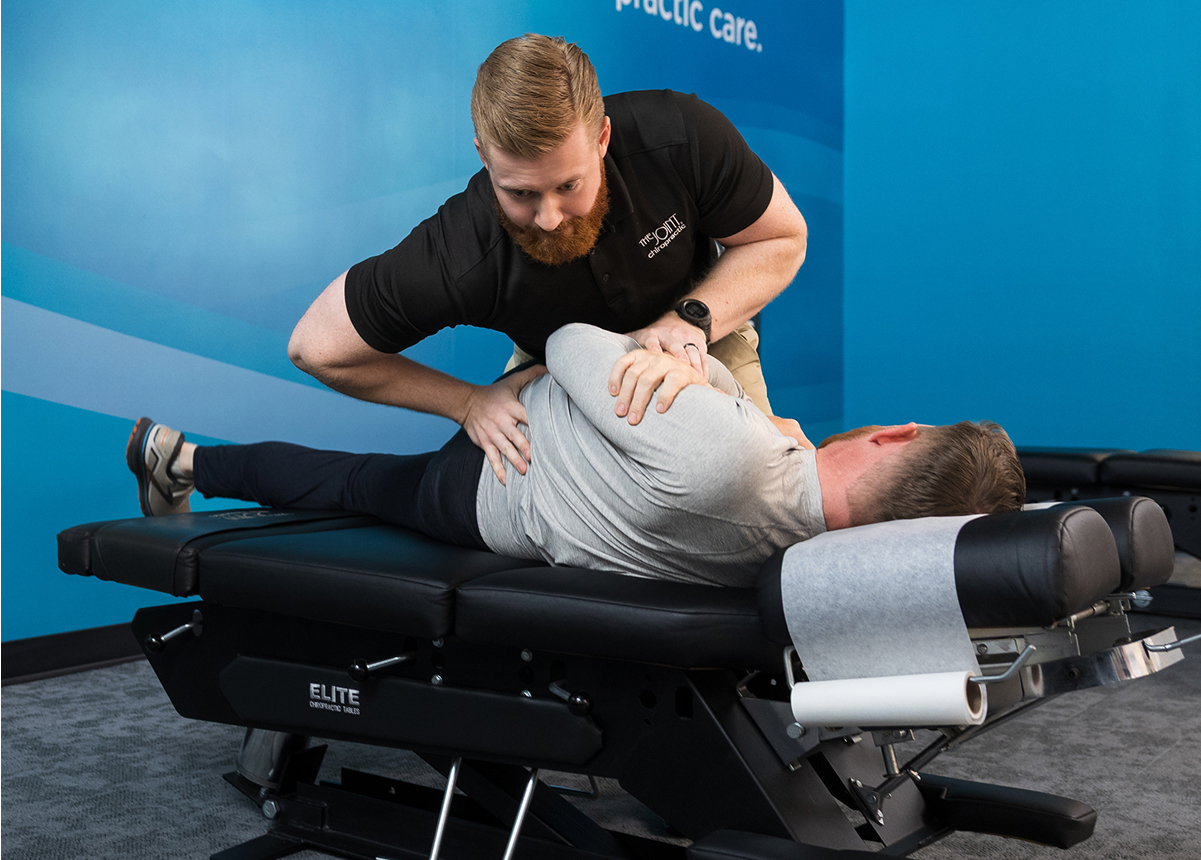
Chiropractic adjustments are precise, gentle movements applied to specific joints that aren’t moving well. When done correctly, adjustments can:
- Improve joint motion
- Reduce local inflammation and irritation
- Help muscles relax and move more normally
- Decrease pressure on irritated nerves
Many patients describe this as a sense of “release” or “unwinding” in the low back. Patients often exclaim that they feel “taller” or “lighter” as they walk out of the office.
Reducing Muscle Tension and Guarding
When joints are stiff or irritated, muscles around them often tighten to protect the area. By restoring more normal joint motion, chiropractic care can:
- Calm muscle spasm
- Improve blood flow
- Allow better activation of stabilizing muscles
Your chiropractor may also recommend or demonstrate simple stretches and exercises to reinforce this between visits.
Supporting Better Movement Patterns Over Time
The goal of chiropractic care isn’t just to get you through this week. It’s to help you improve your overall quality of life. That means life is better because you are:
- Improving posture and body mechanics
- Learning safer bending and lifting patterns
- Improving your posture and exercising pain free
This is where consistency matters. One adjustment can be helpful, but a series of visits paired with better habits is usually what creates lasting change feeling better than you have for years.
Research Spotlight: What the Evidence Says
While every person is different, several peer-reviewed studies support chiropractic and spinal manipulation as part of a low back pain care plan:
- Clinical practice guideline:
A guideline from the American College of Physicians, published in Annals of Internal Medicine in 2017, recommends nonpharmacologic therapies such as spinal manipulation [chiropractic], exercise, and other conservative care as first-line treatments for acute, subacute, and chronic low back pain. (1) - Randomized clinical trial (JAMA Network Open):
In 2018, Goertz and colleagues published a trial in JAMA Network Open involving US service members with low back pain. Patients who received usual medical care plus chiropractic care had greater improvements in pain intensity, disability, and satisfaction than those receiving usual medical care alone, with no serious treatment-related adverse events reported. (2) - Systematic review & meta-analysis (BMJ):
A 2019 systematic review in BMJ by Rubinstein et al. found that spinal manipulative therapy produced similar improvements in pain and function as other guideline-recommended interventions for chronic low back pain, with mostly minor, transient adverse events. (3) - Quality of life study (Spine):
A prospective observational study published in Spine in 2019 by Hays and colleagues followed over 2,000 patients with chronic low back or neck pain receiving chiropractic care across more than 100 clinics. Over three months, patients experienced significant group-level improvements in health-related quality of life, particularly in pain and physical functioning. (4)
These studies don’t promise identical results for every individual, but they support what millions of patients experience: chiropractic care can play a valuable role in reducing pain and improving function as part of a broader, noninvasive plan.

Working Together With Other Providers
Chiropractic care often works best as part of a team approach. Many patients we see at The Joint Chiropractic are also:
- Under the care of a primary care physician
- Working with a physical therapist
- Seeing a pain specialist or other provider
We aim to:
- Focus on spine and joint function, posture, and movement
- Support exercise and rehab plans from other providers
- Help reduce reliance on medications where appropriate (under a physician’s guidance)
Chiropractic care is designed to complement, not replace, appropriate medical care. When needed, your chiropractor can recommend further evaluation or co-management.
What to Expect at The Joint Chiropractic in the Southeast Valley
The Joint Chiropractic model is built around convenience, affordability and consistency: walk-in care, affordable pricing, and multiple locations so you can actually stick with the plan.
Convenient-Chiropractic.com highlights five Joint clinics throughout the East Valley in communities like Gilbert, Queen Creek, East Mesa, and San Tan Valley.
Here’s what a typical experience looks like:
Your First Visit: Consultation and Exam
On your first visit, your chiropractor will:
- Take a focused history: where it hurts, how long it’s been going on, what makes it better or worse, your work and activities, and any past injuries
- Perform an exam: posture, range of motion, specific orthopedic tests, and palpation of the joints and muscles in your spine and hips
- Explain what they find in plain language
If chiropractic care is appropriate and safe, they’ll recommend a plan and usually begin treatment that same day.
Note: At many Joint locations, new patients can receive their initial consultation, exam, and adjustment at a special introductory price, making it easier to get started.
Your Care Plan: Focused, Practical, and Doable
Care for low back pain usually includes:
- A series of adjustments aimed at restoring motion and reducing irritation
- Recommendations for short, simple exercises or stretches
- Tips for sitting, sleeping, and lifting that fit your real life
Because The Joint’s clinics offer walk-in hours and membership plans and package options with low per-visit costs, it’s easier to follow through even with a busy schedule living in the Phoenix valley.
Why Convenience Matters for Back Pain Recovery
For your spine, consistency beats intensity. A care plan you can actually follow with quick visits on the way home from work or a stop after dropping kids at practice, is far more powerful than an office that loads you up with dozens of treatments, stretches and exercises in one or two visits.
Walk-in hours, multiple locations, and straightforward pricing are not just marketing features, they’re practical tools that make it easier for you to:
- Get adjusted consistently to beat the pain
- Pair care with realistic lifestyle changes
- Stay ahead of future flare-ups
Ongoing Care and Maintenance
Some patients come in for a period of focused care during a flare-up, then taper down. Others choose ongoing wellness visits to keep their back moving well and reduce the risk of future flare-ups.
Your chiropractor will talk with you about what makes sense based on your goals, schedule, and how your back responds.
Special Considerations: Pregnancy, Older Adults, and Active People
- Pregnancy: As the body changes, the low back and pelvis can experience extra stress. Gentle chiropractic techniques may help improve comfort and mobility during pregnancy. Always inform your chiropractor if you’re pregnant so they can tailor care appropriately. Chiropractic is absolutely safe for pregnant women and their babies.
- Older adults: Stiffness, arthritis, and balance concerns are common. Chiropractors can use lower-force techniques and focus on improving movement, comfort, and everyday function—things like standing up, walking through the grocery store, and getting around the house.
- Active adults & athletes: From hikers in the Superstitions to weekend golfers and gym-goers, chiropractic care can help address movement restrictions that contribute to recurring strains and flare-ups, so you’re not constantly worrying if you’ll “pay for it” the next day.
Your chiropractor will always tailor care based on age, health history, and comfort level.
Practical Ways to Help Low Back Pain at Home
While chiropractic care focuses on improving movement and joint function, what you do between visits is just as important.
- For Low Back Pain That Won’t Go Away
If pain lasts more than 10–14 days or keeps coming back, it’s usually time to:
- Get a professional evaluation
- Rule out anything serious
- Start a targeted plan that includes adjustments, exercises, and lifestyle changes
Chronic pain typically improves faster when you address both the symptoms and the underlying issues, instead of just resting and hoping it goes away.
- Easing Low Back Pain at Night
Night-time back pain is frustrating. Simple changes can help:
- Sleep on your back with a pillow under your knees, or on your side with a pillow between your knees
- Use a supportive, not overly soft, mattress
- Do a few gentle stretches (like knee-to-chest or child’s pose) before bed if your chiropractor has cleared them for you
If you frequently wake up stiff or sore, mention your sleep position and mattress to your chiropractor. Small adjustments here can make a big difference.
- Relieving Low Back Pain from Sitting All Day
To reduce sitting-related pain:
- Stand, walk, or stretch every 30–45 minutes
- Keep your feet flat on the floor and avoid crossing your legs for long periods
- Use a small lumbar support or rolled-up towel behind your lower back
- Keep screens at eye level so you’re not slumping forward
- Engage your core lightly instead of hanging on your ligaments
How to Set Up Your Chair in 5 Simple Steps
- Sit with your hips all the way back in the chair.
- Adjust chair height so your feet are flat and knees are roughly level with or slightly below your hips.
- Place a lumbar support, small cushion or rolled towel in the curve of your lower back.
- Bring your screen up so you’re looking straight ahead (or within 10 degrees of horizontal), not down.
- Try to keep your elbows on your chair arm rests.
- Keep your mouse and keyboard close so your shoulders can relax.
Your chiropractor can also review your workstation setup and suggest simple ergonomic tweaks by bringing in a picture of you at your work station.
- Can Walking Help Low Back Pain?
Often, yes. Walking:
- Activates key stabilizing muscles around your spine and hips
- Improves blood flow to discs, muscles, and ligaments
- Helps reduce stiffness from prolonged sitting or standing
Start with short, comfortable walks and gradually increase time and pace. If walking makes your pain significantly worse, talk to your provider first.
- Smart Stretching for Low Back Pain
Gentle stretching can ease tension, but not every stretch is right for every back. Often-helpful options (when appropriate) include:
- Knee-to-chest
- Pelvic tilts
- Child’s pose
- Gentle piriformis and hip flexor stretches
Deep forward bending or aggressive twisting can aggravate certain disc or nerve issues. Your chiropractor can show you a safe routine tailored to your situation.

Why Low Back Pain Keeps Coming Back
Recurring low back pain isn’t a “mystery pain.” The pain is coming from somewhere. Persistent pain is typically a sign that underlying issues haven’t really been corrected, such as:
- Rounded posture at your desk or in the car
- Lifting with your back instead of your legs and hips
- Weak core and glutes
- Unsupportive sleep positions
- Skipping strength and mobility work
Chiropractic adjustments help restore motion and reduce irritation, but long-term success usually comes from pairing care with better habits. That’s why your chiropractor may talk about exercises, ergonomics, and stress management, not just what happens on the table.
Real Patient Experiences with Low Back Pain and The Joint (Individual Results May Vary)
“I cannot speak highly enough of Dr. Nick and the entire team at The Joint in Queen Creek. When I first came in, I was dealing with a lot of discomfort in my low back and hips and honestly feeling discouraged—especially after repeatedly being asked if I was pregnant, despite being very fit and active.
Dr. Nick took the time to really listen, assess, and provide an adjustment that gave me noticeable relief in a way I didn’t even realize I needed. It felt like my body was finally aligned again. That first experience was so positive that I kept coming back—and every visit since has been just as supportive and effective.
The staff is always warm, welcoming, and professional. I feel genuinely cared for every time I walk in. If you’re looking for chiropractic care from someone who truly understands the body and treats patients with compassion and skill, I highly recommend Dr. Nick and the team at The Joint Chiropractic in Queen Creek.”
– L. Fernandez.
“I absolutely love this place and this location. After a hip injury, I could barely use my right leg and was struggling to walk without pain. After several months of PT and seeing Dr. Rafic at The Joint in East Mesa, I’m now walking comfortably and living pain free. I would recommend coming here to anyone who is dealing with discomfort.”
– J. Ralph.
These experiences don’t guarantee specific outcomes for every person, but they do reflect the kind of changes many patients report when they combine chiropractic care with better everyday habits.
Common Questions About Chiropractic for Low Back Pain
Is chiropractic safe for low back pain?
For most people, chiropractic care is a safe, noninvasive option. Like any healthcare intervention, there are risks and side effects, but serious complications are rare when care is provided by a licensed, trained chiropractor. Your doctor of chiropractic will review your history and exam findings to make sure you’re a good candidate.
How many visits will it take to feel better?
It varies. Some people feel improvement after a few visits; others with longer-standing or more complex problems may need a series of visits over several weeks. Your chiropractor will outline a plan and check your progress along the way.
Do I need X-rays for low back pain?
Not always. Many cases of mechanical low back pain can be evaluated without imaging. X-rays or other tests are typically considered when your history or exam suggests something more serious, or when symptoms aren’t improving as expected.
What if my back feels sore after an adjustment?
Mild soreness – similar to how you might feel after starting a new exercise—can happen as stiff joints begin to move again and muscles adjust to a new pattern. This usually fades within a day or two. If something feels off or your symptoms worsen, let your chiropractor know so they can adjust your care plan.
Can I see a chiropractor if I’m already seeing another provider?
Absolutely. Many patients use chiropractic care alongside medical, physical therapy, or other treatments. Your chiropractor can be part of a team focused on improving your function and reducing pain with the least invasive options possible.
Finding Low Back Pain Relief at Our Southeast Valley Clinics
Low back pain can make everything harder. From tying your shoes to getting through a workday or enjoying time with family. The good news is that for many people, a combination of chiropractic care, better movement, and smarter habits can make a real difference.
The Joint Chiropractic clinics in Gilbert-San Tan Village, Queen Creek, East Mesa and San Tan Valley bring that approach to life with:
- Walk-in visits no appointments needed
- Affordable care without any insurance needed
- Five convenient locations in Southeast Valley communities like Gilbert, Queen Creek, Mesa, and San Tan Valley with additional access to almost 1,000 clinics nationwide
- Evening and weekend hours so care fits your schedule
If you’re tired of wondering how to help your low back pain and ready to try a non-drug, movement-focused approach, we’d love to see you.
Next step:
Visit Convenient-Chiropractic.com, find the Joint Chiropractic clinic closest to you, and stop by for an evaluation. Let’s get your low back and your life moving in a better direction.
Common Questions About Chiropractic for Low Back Pain
Is chiropractic safe for low back pain?
For most people, chiropractic care is a safe, noninvasive option. Like any healthcare intervention, there are risks and side effects, but serious complications are rare when care is provided by a licensed, trained chiropractor. Your doctor of chiropractic will review your history and exam findings to make sure you’re a good candidate.
How many visits will it take to feel better?
It varies. Some people feel improvement after a few visits; others with longer-standing or more complex problems may need a series of visits over several weeks. Your chiropractor will outline a plan and check your progress along the way.
Do I need X-rays for low back pain?
Not always. Many cases of mechanical low back pain can be evaluated without imaging. X-rays or other tests are typically considered when your history or exam suggests something more serious, or when symptoms aren’t improving as expected.
What if my back feels sore after an adjustment?
Mild soreness – similar to how you might feel after starting a new exercise—can happen as stiff joints begin to move again and muscles adjust to a new pattern. This usually fades within a day or two. If something feels off or your symptoms worsen, let your chiropractor know so they can adjust your care plan.
Can I see a chiropractor if I’m already seeing another provider?
Absolutely. Many patients use chiropractic care alongside medical, physical therapy, or other treatments. Your chiropractor can be part of a team focused on improving your function and reducing pain with the least invasive options possible.
Finding Low Back Pain Relief at Our Southeast Valley Clinics
Low back pain can make everything harder. From tying your shoes to getting through a workday or enjoying time with family. The good news is that for many people, a combination of chiropractic care, better movement, and smarter habits can make a real difference.
The Joint Chiropractic clinics in Gilbert-San Tan Village, Queen Creek, East Mesa and San Tan Valley bring that approach to life with:
- Walk-in visits no appointments needed
- Affordable care without any insurance needed
- Five convenient locations in Southeast Valley communities like Gilbert, Queen Creek, Mesa, and San Tan Valley with additional access to almost 1,000 clinics nationwide
- Evening and weekend hours so care fits your schedule
If you’re tired of wondering how to help your low back pain and ready to try a non-drug, movement-focused approach, we’d love to see you.
Next step:
Visit Convenient-Chiropractic.com, find the Joint Chiropractic clinic closest to you, and stop by for an evaluation. Let’s get your low back and your life moving in a better direction.
Disclaimer
This article is for general informational purposes only and does not provide medical or chiropractic diagnosis or treatment recommendations for any individual person. Always consult a qualified healthcare professional for an examination, diagnosis, and personalized treatment plan.
Selected Research References
- Qaseem A, Wilt TJ, McLean RM, Forciea MA. Noninvasive treatments for acute, subacute, and chronic low back pain: a clinical practice guideline from the American College of Physicians. Ann Intern Med. 2017;166(7):514–530. doi:10.7326/M16-2367.
- Goertz CM, Long CR, Vining RD, et al. Effect of usual medical care plus chiropractic care vs usual medical care alone on pain and disability among US service members with low back pain: a comparative effectiveness clinical trial. JAMA Netw Open. 2018;1(1):e180105. doi:10.1001/jamanetworkopen.2018.0105.
- Rubinstein SM, de Zoete A, van Middelkoop M, et al. Benefits and harms of spinal manipulative therapy for the treatment of chronic low back pain: systematic review and meta-analysis of randomised controlled trials. BMJ. 2019;364:l689. doi:10.1136/bmj.l689.
- Hays RD, Herman PM, Spritzer KL, et al. Group and individual-level change on health-related quality of life in chiropractic patients with chronic low back or neck pain. Spine (Phila Pa 1976). 2019;44(9):647–651. doi:10.1097/BRS.0000000000002947 (doi from abstracted sources).