Quick Highlights
- The Cause: Sitting keeps your spine in a fixed, rounded position that raises pressure on your lower back discs and slowly tightens your hip flexors.
- The Pattern: Back pain from sitting usually builds through the day and eases a little once you stand up, which is a clue about what’s actually driving it.
- Quick Relief: Short movement breaks, a properly adjusted chair, and a few targeted stretches can take the edge off the same day.
- The Deeper Issue: Stretching loosens tight muscles, but it doesn’t restore normal motion to genuinely restricted spinal joints.
- Easy Local Access: The Joint Chiropractic offers walk-in care at six Southeast Valley locations; no appointment or insurance is required.
- New Patient Offer: Your first visit is only $29 and includes your consultation, a spinal exam, and your first adjustment.
Table of Contents
- Why Does Sitting All Day Cause Back Pain?
- Does Your Desk Setup Make It Worse?
- What Can You Do Right Now to Relieve Back Pain From Sitting?
- Simple Daily Habits to Protect Your Spine During Long Workdays
- Why Stretching Alone Doesn’t Always Fix Back Pain From Sitting
- How Chiropractic Adjustments Restore Joint Mobility
- What to Expect at The Joint Chiropractic
- Frequently Asked Questions About Back Pain From Sitting
Why Does Sitting All Day Cause Back Pain?
When you sit, especially slouched forward toward a screen, your spine loses its natural curve and your lower back rounds out. That position puts more load on the discs between your vertebrae than standing does, and it stays that way for as long as you’re in the chair. At the same time, your hip flexors, the muscles that connect your thighs to your lower spine, shorten from staying bent for hours. Your glutes and core, the muscles that are supposed to support your spine, go quiet from disuse.
The Cleveland Clinic points to weak core muscles as a real contributor to back strain, noting that “weakened abdominal muscles can’t properly support your spine,” which leaves your lower back doing more work than it should. Add hours of stillness on top of that, and it’s a setup for the dull, achy tightness that shows up by mid-afternoon and gets worse the longer you stay seated.
Does Your Desk Setup Make It Worse?
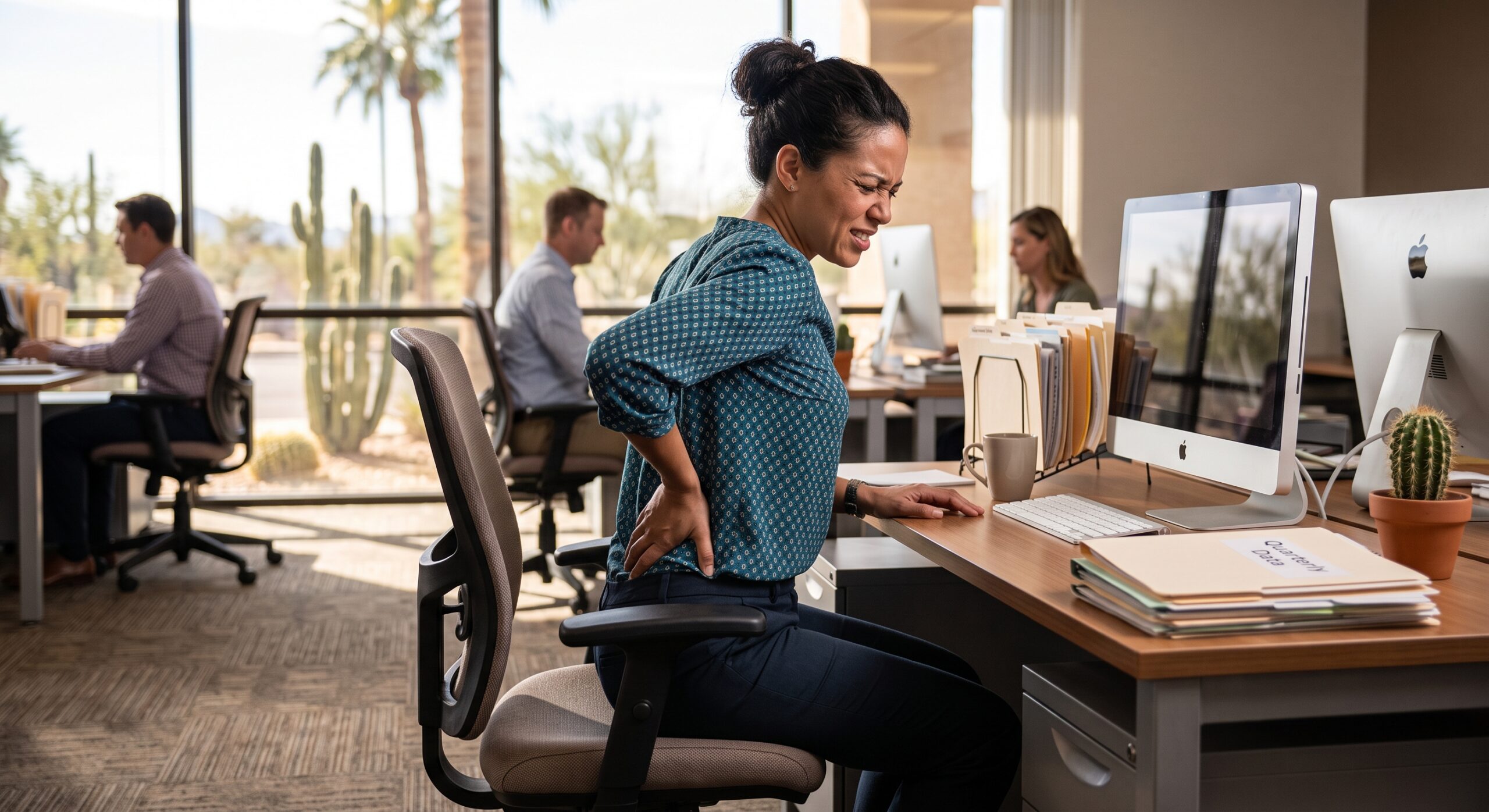
A chair that’s too low, a monitor that forces you to lean forward, or a keyboard set too high can all make your posture worse without you noticing. Mayo Clinic’s office ergonomics guidance (1) recommends keeping your feet flat on the floor with your thighs parallel to it, positioning your screen about an arm’s length away with the top of the display at or slightly below eye level, and keeping your wrists straight with your upper arms close to your body. Small adjustments like these take pressure off your lower back and neck over the course of a full workday.
Mayo Clinic also notes that even with a perfect setup, “sitting in the same position for hours at a time isn’t good for your body,” no matter how ergonomic the chair is. Good posture reduces strain, but it doesn’t replace the need to move.
What Can You Do Right Now to Relieve Back Pain From Sitting?
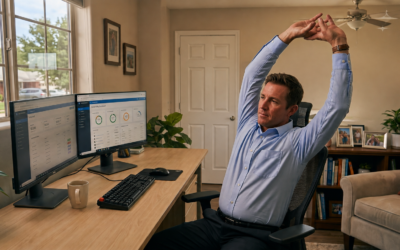
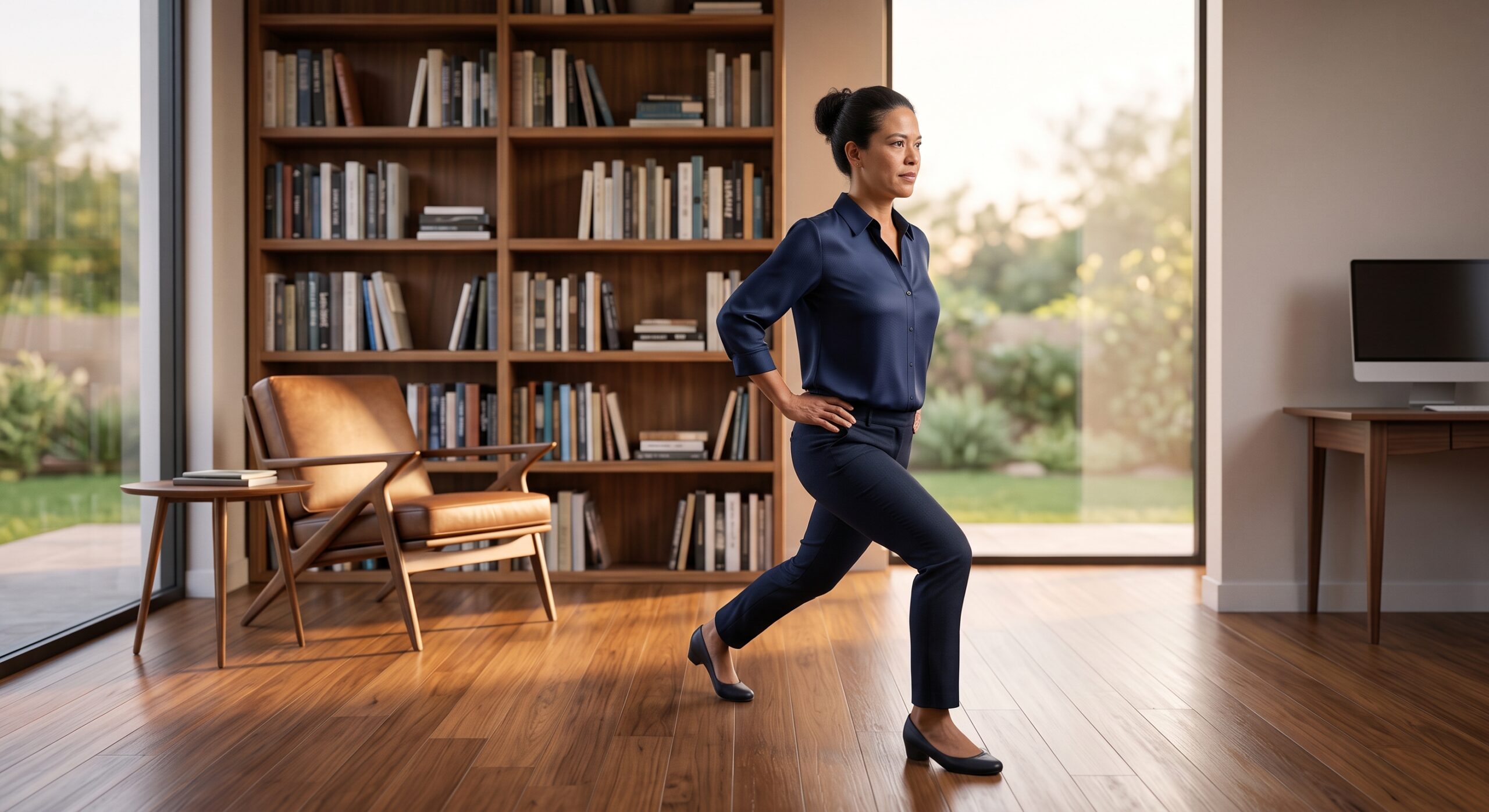
If your back is already tight, a few things can help before the day is over. Stand up and walk for a minute or two every thirty to sixty minutes rather than waiting for a natural break. A standing hip flexor stretch, where you step one foot forward into a gentle lunge and hold for twenty to thirty seconds on each side, directly counters the shortening that happens from sitting. Cat-cow style movement, arching and rounding your back slowly while seated or on hands and knees, can also loosen a stiff spine.
Standing desks help some people, but they’re not a complete fix on their own. Switching between sitting and standing throughout the day, rather than staying locked in either position, tends to work better than either one alone. Staying active outside of work matters too. Cleveland Clinic notes that “staying active increases blood flow to the area and helps you heal,” which is part of why gentle movement usually beats total rest for everyday back stiffness.
Simple Daily Habits to Protect Your Spine During Long Workdays
Long-term spinal health comes down to consistency. Incorporating a few foundational habits into your daily routine helps prevent back strain before it starts:
- Use the 30-Minute Movement Rule: Set a subtle timer to stand, stretch, or walk for at least 60 seconds every half hour.
- Keep Core and Glute Muscles Engaged: Perform brief bodyweight squats or standing glute squeezes during breaks to reactivate muscles turned off by prolonged sitting.
- Stay Hydrated Throughout the Day: Spinal discs rely on adequate hydration to maintain their cushioning properties and absorb daily shock.
- Optimize Lumbar Support: Place a small lumbar roll or rolled-up towel behind your lower back to maintain your natural spinal curve while seated.
Why Stretching Alone Doesn’t Always Fix Back Pain From Sitting
Here’s the part that catches a lot of people off guard. You stretch, you feel better for an hour or two, and then the same tightness creeps back in the next afternoon. That cycle usually means the stretching is relieving the muscles around the problem without addressing the joint that’s actually restricted.
When a spinal joint loses its normal range of motion, the muscles around it tighten up to compensate and protect the area. Stretching those muscles feels good and buys you temporary relief, but the joint underneath is still not moving the way it should. Until that restriction is addressed directly, the muscles are instinctively going to tighten to protect the underlying joint problem, so the tightness returns. That’s the difference between managing the symptom and getting to what’s actually causing it.
How Chiropractic Adjustments Restore Joint Mobility
While stretching lengthens tight muscle fibers, a chiropractic adjustment targets the restricted spinal joints underneath that cause those muscles to spasm in the first place.
By applying a gentle, targeted force to restricted vertebrae, a Doctor of Chiropractic helps restore normal joint motion, reduce local inflammation, and relieve pressure on nearby nerves. Once the joint moves freely again, surrounding muscles no longer need to stay locked in a defensive, tight state, providing more lasting relief throughout your workday.
What to Expect at The Joint Chiropractic
If afternoon lower back tightness persists despite stretching, a licensed Doctor of Chiropractic at The Joint Chiropractic can evaluate your spinal mobility, identify restricted joints, and perform a same-day adjustment to treat the root cause. Visits begin with a focused health history and spinal exam, with no appointments or insurance required, and you can explore our guide on what to expect at your first chiropractic visit to learn more about the entire process.
Walk-in care is available at all six Southeast Valley locations: Power Ranch, Mesa Gateway, San Tan Village, Queen Creek, San Tan Valley, and Hunt Highway.
Here are the reviews of some of our patients :
“Hands down best decision ever to go to this location after a back injury… I was in a lot of pain and had travel plans within a few [days]… The doctor assessed me very well during my first visit and provided the care I needed, as well as guided me about at-home care.” — I. Senarath
“After injuring my back, my wife recommended The Joint at Power & Ray in Mesa. He was great! He listened to my concerns and customized treatment to my needs… My back is doing fine now.” — B. Brines
Frequently Asked Questions About Back Pain From Sitting
Is back pain from sitting all day serious?
Usually not on its own. Most sitting-related back pain comes from muscle tightness and joint stiffness rather than a serious underlying condition. That said, pain that doesn’t ease up with movement, or that spreads down a leg, is worth having evaluated.
How long does it take for back pain from sitting to go away?
Mild stiffness from a long day at a desk often eases within a day or two once you get moving again. If the same tightness keeps returning day after day despite stretching and movement breaks, that’s usually a sign something is being masked rather than fixed.
Can a standing desk fix back pain from sitting?
It can help, especially when you alternate between sitting and standing rather than staying still in either position. A standing desk alone won’t fix an already-restricted spinal joint, though.
Is stretching enough to fix back pain from a desk job?
Stretching helps in the moment, but it mainly addresses the tight muscles around the problem rather than the joint restriction driving the tightness. That’s why the same stiffness tends to come back on a predictable schedule.
Do I need an appointment at The Joint Chiropractic in the Southeast Valley?
No. All six Southeast Valley locations- Power Ranch, Mesa Gateway, San Tan Village, Queen Creek, San Tan Valley, and Hunt Highway- offer walk-in chiropractic care with no appointment and no insurance needed.
Stop Letting Your Desk Job Run Your Back
If the ache shows up like clockwork every afternoon, your body is telling you something a stretch break can’t fully answer. At The Joint Chiropractic, our licensed Doctors of Chiropractic find the specific joints that are actually restricted and get them moving again, so your muscles can finally relax instead of compensating all day.
Walk into any of our six Southeast Valley locations today. Your first visit, including the consultation, spinal exam, and first adjustment, is just $29.
Disclaimer
This article is for general informational purposes only and does not provide medical or chiropractic diagnosis or treatment recommendations for any individual person. Always consult a qualified healthcare professional for an examination, diagnosis, and personalized treatment plan.
References
1. Mayo Clinic. (2023). Office ergonomics: Your how-to guide. Mayo Foundation for Medical Education and Research. https://www.mayoclinic.org/healthy-lifestyle/adult-health/in-depth/office-ergonomics/art-20046169
Cleveland Clinic. (2024). Lower back pain. https://my.clevelandclinic.org/health/diseases/7936-lower-back-pain
National Center for Complementary and Integrative Health. (2023). Chiropractic: In depth. U.S. Department of Health & Human Services. https://www.nccih.nih.gov/health/chiropractic-in-depth