
Quick Highlights
Heading out from the Southeast Valley for a weekend in Sedona, San Diego, or Vegas? Here’s what to know to help keep your back more comfortable on a long drive:
- Why long drives can leave your lower back and hips stiff or sore.
- How to adjust your seat and driving position to reduce strain on your back.
- How often to stop, move, and stretch during a road trip.
- Simple stretches to try at rest stops during longer Arizona and Southwest drives.
- What to do when back pain lingers after you get home.
- When to see a chiropractor for back pain after a long drive, including walk-in options in the Southeast Valley.
Table of Contents
- Why Do Long Drives Cause Back Pain?
- How Can You Prevent Back Pain on a Road Trip?
- Quick Rest-Stop Stretches to Reset Your Spine
- What Should You Do If Back Pain Doesn’t Go Away After a Trip?
- Frequently Asked Questions About Road Trip Back Pain
- What Do Patients Say About Chiropractic Care for Back Pain?
Maybe you just got back from a weekend in Sedona, or you’re loading the car for a trip to San Diego. Either way, you know the feeling. You step out of the car, and your lower back feels locked up. Your hips are tight. For many Southeast Valley drivers, that’s just part of road trip season. It doesn’t have to be. A few small changes before and during the drive can keep your back from paying the price.
Why Do Long Drives Cause Back Pain?
Sitting for a long stretch puts steady pressure on the discs in your lower back. Your hips stay bent, your core turns off, and the muscles around your spine tighten up. Add in road vibration and a seat with no support, and it’s no surprise you feel it by the time you hit Tucson or the California line. According to Banner Health (1), drivers who sit for long stretches without a break are more likely to end up with stiffness and muscle tension.
How Do Road Vibration and Muscle Fatigue Affect Your Back?
Driving is far from a passive activity for your musculoskeletal system. As your vehicle travels over uneven pavement and highway expansion joints, continuous low-frequency vibrations pass directly through the car seat into your pelvis and lumbar vertebrae. To stabilize your spine against these micro-impacts, your deep postural muscles stay in low-level contraction for hours. This sustained effort reduces local blood flow, depletes cellular oxygen, and leaves your lower back stiff and inflamed by the time you arrive.
How Seat Distance, Pedal Reach, and Leg Position Affect Your Back While Driving Long Distances
How far your seat is from the pedals directly influences your pelvis angle. Sitting too far back forces you to stretch your legs to reach the pedals, which pulls the hamstrings taut, flattens the natural lumbar curve, and places direct tension on the sciatic nerve.
Also, sitting too close bunches up the hip flexors, cramming the knees higher than the hips and drastically increasing compressive loads on your lower spinal discs. Adjust your seat track so your knees stay slightly bent when you depress the pedals fully, letting your feet operate the controls with minimal hip movement.
What Can You Do Before a Long Drive to Prevent Back Pain?
Tips for Setting Up Your Car to Prevent Back Pain
Small tweaks to your seating setup have a surprisingly large effect on your body. Recline the backrest slightly, around 100 to 110 degrees, instead of sitting bolt upright. (90 degrees would be straight up). Slide your hips all the way back in the seat. Keep your hands relaxed on the wheel instead of gripping it tight. If your lower back doesn’t
How Should You Set Up Your Car Before a Long Drive?
Spending hours behind the wheel places sustained static pressure on your lumbar spine, hips, and neck. Optimizing your car’s cockpit before you shift into drive helps prevent stiffness, muscle fatigue, and sciatic irritation.
What is the ideal seat angle and distance to prevent back strain?
- Seat distance: Position the seat so your knees stay slightly bent (around 120 degrees) when you press the pedals all the way down. Sitting too far away forces you to reach, which flattens your lower back; sitting too close cramps your hips and strains your knees.
- Backrest recline: Angle the backrest between 100 and 110 degrees rather than bolt upright at 90 degrees. A slight recline significantly lowers disc pressure in the lower back without forcing your neck to jut forward.
- Seat pan height: Elevate the seat until your hips are level with or slightly higher than your knees. This open hip angle reduces tension on the hip flexors and prevents pelvic tucking.
How should you adjust lumbar support to protect the lower spine?
- Align the car’s built-in lumbar contour directly into the natural curve of your lower back, just above the beltline. It should fill the gap comfortably without pushing your spine into an exaggerated arch.
- If your vehicle lacks built-in lumbar controls, place a rolled towel, small lumbar cushion, or specialized orthopedic back roll vertically along the spine or horizontally at belt level to maintain the natural inward lordotic curve.
Where should the headrest and steering wheel be positioned?
- Headrest: Adjust the center of the headrest to sit level with the top of your ears, with no more than 1 to 2 inches between the pad and the back of your head. This prevents cervical whiplash during sudden stops and stops you from leaning your neck forward.
- Steering wheel: Tilt the wheel down so it aims toward your chest rather than your face. Ensure you can grip the wheel at the 9-and-3 or 8-and-4 positions with relaxed shoulders and slightly bent elbows. Avoid reaching straight out, which pulls the upper trapezius and rhomboids into chronic tension.
What should you remove from your pockets before driving?
- Empty your back pockets completely. Sitting on a wallet, phone, or set of keys creates an uneven pelvis, tilts the sacrum, and forces the lumbar spine into a lateral curve. Over hours of driving, this imbalance can compress the sciatic nerve and trigger sharp lower back or leg pain.
How can you use vehicle mirrors to check posture habits?
- Sit up straight with relaxed shoulders, your back flush against the seat, and your head centered.
- Adjust your rearview and side mirrors to match this optimal posture.
- If you find yourself craning your neck or slouching later to see in the rearview mirror, take it as an immediate visual cue that your posture has collapsed and it is time to reset.
Quick Rest-Stop Stretches to Reset Your Spine
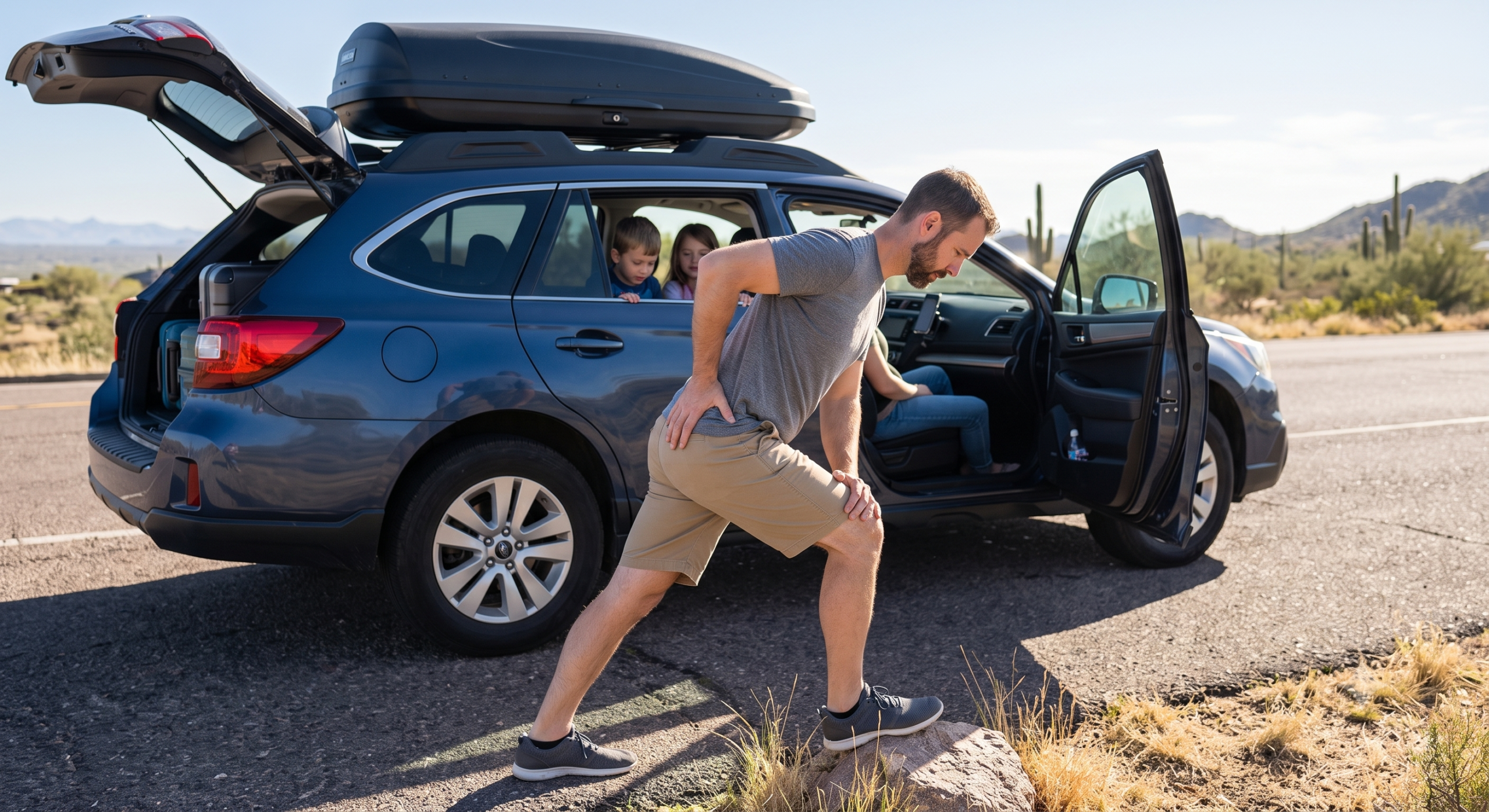
Taking a brief five-minute break every hour gives your spinal tissues a much-needed break from static compression.
Standing Back Extensions
This movement gently reverses forward slouching and hunched posture from prolonged sitting, instantly decompressing the front of the lumbar spine.
Why it helps: Sitting flattens the natural inward curve (lordosis) of the lower back, pushing disc pressure backward. Controlled back extensions counter that static strain and increase mobility.
How to do it:
- Stand tall with your feet shoulder-width apart.
- Place the palms of your hands firmly on your lower back or hips with your fingers pointing downward.
- Inhale, engage your core slightly, and gently push your hips forward while arching your torso backward.
- Keep your neck relaxed without hyperextending your head backward.
- Hold the position for 3 to 5 seconds, return to the starting upright position, and repeat for 5 to 10 repetitions.
Standing Quad and Hip Flexor Stretch
Prolonged driving or desk work keeps the hips in a constant 90-degree bend, causing the iliopsoas and quadriceps to shorten and pull the pelvis forward.
Why it helps: Tight hip flexors tilt the pelvis anteriorly, which directly increases compressive stress on the lumbar facet joints. Lengthening them takes immediate tension off the lower back.
How to do it:
- Stand near a sturdy surface, such as a car door or desk, to maintain balance.
- Shift your weight to your left leg, bend your right knee, and reach behind to grab your right ankle or foot with your right hand.
- Keep your knees aligned and close together—avoid letting your right knee flare outward.
- Tuck your pelvis slightly under and push your hips gently forward until you feel a comfortable stretch along the front of your thigh and hip.
- Hold for 20 to 30 seconds, breathe steadily, and switch to the other side.
Standing Side Bends
This active stretch targets the quadratus lumborum (QL) and latissimus dorsi—muscles that frequently tighten when you lean toward one armrest or sit unevenly.
Why it helps: Loosening lateral trunk and back muscles restores side-to-side spinal mobility and prevents uneven shearing forces across the sacroiliac (SI) joints.
How to do it:
- Stand with your feet hip-width apart, shoulders down and relaxed.
- Raise your right arm overhead while resting your left hand against your left outer thigh.
- Inhale, lengthen your torso, and slowly bend your upper body to the left side on the exhale.
- Slide your left hand down toward your left knee without letting your torso twist forward or backward.
- Hold the stretch for 15 to 20 seconds, return to the center, and repeat on the opposite side for 2 to 3 sets per side.
Hamstring Stretch
Sitting for long periods puts the hamstrings in a shortened, slack position, which can stiffen the posterior chain and limit pelvic movement.
Why it helps: Tight hamstrings pull downward on the sit bones (ischial tuberosities), flattening the lower back and forcing the lumbar spine to round whenever you bend forward.
How to do it:
- Stand upright and extend your right leg straight out in front of you, resting your heel on the ground with your toes pointed up toward the ceiling.
- Softly bend your left (supporting) knee while keeping your right leg straight.
- Hinge forward at your hips—keeping your spine straight and chest open—until you feel a clean stretch through the back of your right thigh.
- Avoid rounding your shoulders or curving your back to reach your foot.
- Hold the position for 20 to 30 seconds while taking deep, slow breaths, then switch legs.
What Should You Do If Back Pain Doesn’t Go Away After a Trip?
A little stiffness after a long drive usually improves with movement and time. But if your back pain isn’t getting better after a few days, or it returns every time you travel, there are a few things you can do:
-
Keep moving gently. Short walks and comfortable movement can help prevent additional stiffness. Avoid activities that make the pain worse.
-
Adjust your daily routine. Take breaks from prolonged sitting, change positions regularly, and pay attention to your posture.
-
Try heat or ice. Heat can help relax tight muscles, while ice may ease soreness after a recent strain. Use whichever provides more comfort.
-
Get your back evaluated. If the pain persists, worsens, or keeps returning, a healthcare professional can assess what’s contributing to it and recommend appropriate care.
Research from the National Center for Complementary and Integrative Health (1) shows chiropractic care can lead to real improvements in pain and function for people dealing with low back pain. A licensed Doctor of Chiropractic can find out what’s going on instead of leaving you to wait it out again next trip.
If your back is still bothering you after a long drive, whether it’s a recent strain or stiffness you’ve dealt with for years, stop by The Joint Chiropractic. Our experienced Doctors of Chiropractic will examine your spine, identify restrictions in joint movement, and explain how chiropractic care can help you move more comfortably. With six Southeast Valley locations and no appointment needed, you can walk in when it’s convenient for you.
Frequently Asked Questions About Road Trip Back Pain
Why does my back hurt so much after a road trip?
Sitting still for hours puts pressure on your spine and tightens the surrounding muscles.
How often should I stop and stretch on a long drive?
Aim for a short break every hour. Even five minutes of walking helps.
Is it normal to have back pain every time I drive long distances?
It happens often, but you don’t have to keep living with it. A regular pattern is worth an evaluation.
Do I need an appointment at The Joint Chiropractic in the Southeast Valley?
No. All five locations offer walk-in care with no insurance needed.
Ready to take the next step? Visit any of our five Southeast Valley clinics for a consultation, spinal examination, and adjustment. Walk-ins are always welcome, and your first visit is just $29.
What Do Patients Say About Chiropractic Care for Back Pain?
Every patient’s experience is different. Here are a few comments from patients who visited our Power Ranch clinic.
“I was in so much pain before I started, and in one month I was able to do so many things that I couldn’t do before, like even tying my shoes with no pain.” J. White
“I found The Joint while I was having a terrible time with sciatica and couldn’t take the pain anymore. One visit fixed me, so I went back for a follow-up and have been visiting regularly ever since. I feel better than ever…” C.Halvorson
“I had the worst back pain I’ve ever experienced and felt 100% better after a week. The environment is so welcoming as well.” – C. Wilson
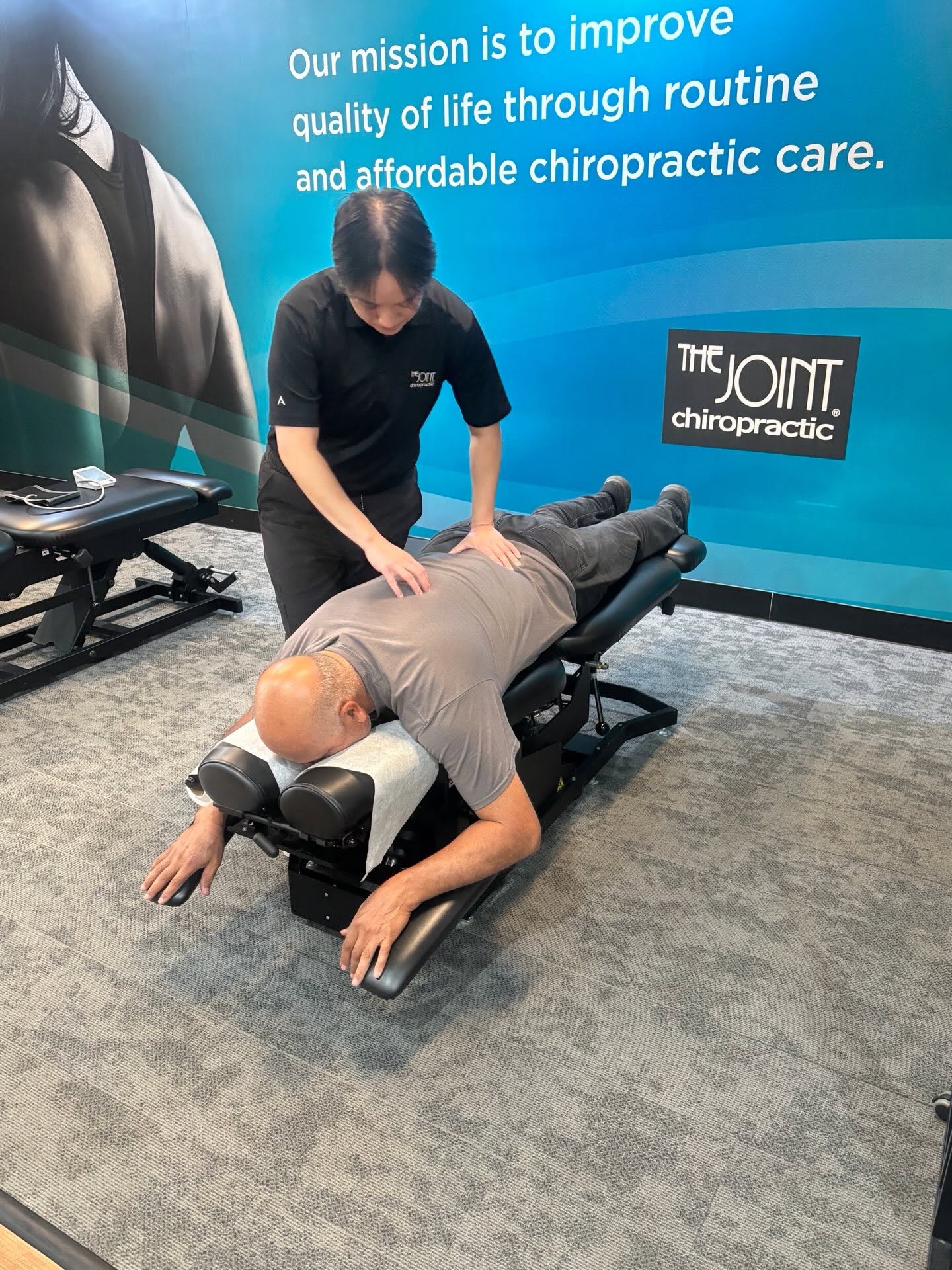
When you visit one of our Southeast Valley clinics, a licensed Doctor of Chiropractic will perform a consultation and spinal exam to understand what’s causing your back pain. We’ll explain our findings, answer your questions, and recommend the right next steps for your symptoms. If chiropractic care is appropriate, treatment focuses on restoring normal joint motion and easing stress on your spine so you can move more comfortably.
The $29 new patient visit covers your consultation, spinal exam, and first adjustment. You can review your options ahead of time on the pricing page.
Walk into your nearest Southeast Valley clinic today: Power Ranch, Mesa Gateway, San Tan Village, Queen Creek, San Tan Valley, and Hunt Highway
If you’d like to know what a first visit involves from start to finish, take a look at our guide on what to expect at your first chiropractic visit.
Disclaimer
This article is for general informational purposes only and does not provide medical or chiropractic diagnosis or treatment recommendations for any individual person. Always consult a qualified healthcare professional for an examination, diagnosis, and personalized treatment plan.
References
(1) Banner Health. (n.d.). Easing back pain when you’re riding in a car. Banner Health. https://www.bannerhealth.com/healthcareblog/better-me/easing-back-pain-when-you-are-riding-in-a-car
(2) National Center for Complementary and Integrative Health. (2024). Spinal manipulation: What you need to know. NCCIH. https://www.nccih.nih.gov/health/spinal-manipulation-what-you-need-to-know