
Quick Highlights
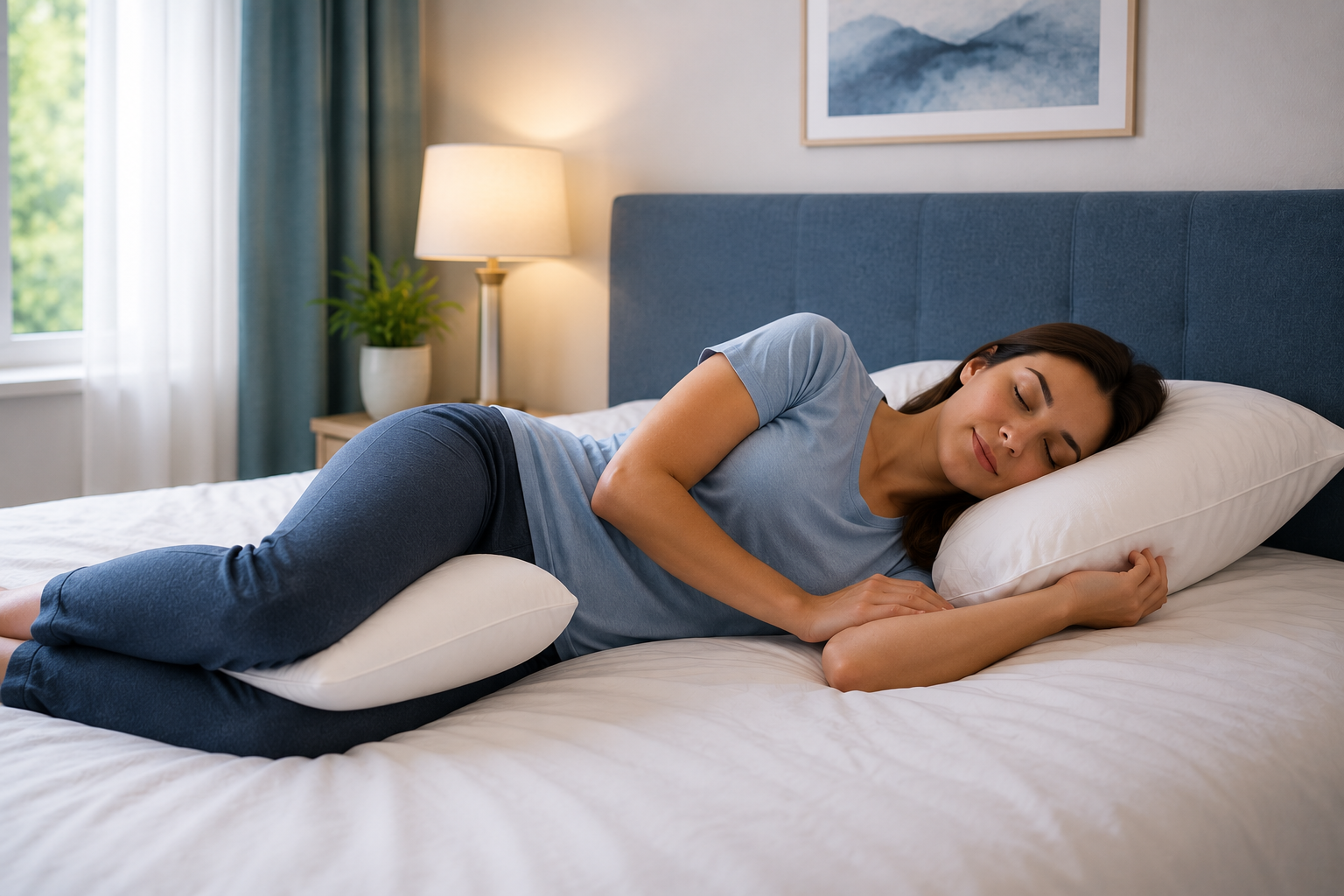
The way you sleep can affect how your neck and lower back feel when you wake up. The right sleep position and pillow setup can help support your spine and reduce unnecessary strain overnight.
In this guide, you’ll learn:
- The best sleep positions for lower back pain.
- The best sleep positions for neck pain.
- How to use pillows to better support your neck and lower back.
- Which sleeping positions can make back or neck pain worse.
- What to try if you still wake up stiff or sore.
- When morning back or neck pain should be evaluated.
Table of Contents
- Can Your Sleeping Position Cause Back or Neck Pain?
- The Best Positions for Low Back Pain
- What Is the Best Sleep Position for Neck Pain?
- How to Choose the Right Pillow for Neck Pain
- Which Sleeping Habits Can Make Back and Neck Pain Worse?
- When Should You See a Chiropractor for Morning Back or Neck Pain?
- What to Expect at Our Southeast Valley Clinics
- Frequently Asked Questions About Sleep Positions and Pain
Can Your Sleeping Position Cause Back or Neck Pain?
If you regularly wake up with a stiff neck or aching lower back, your sleeping position may be contributing to it. Spending several hours with your neck turned, your hips rotated, or your lower back poorly supported can leave you feeling stiff and sore the next morning.
Your spine has three natural curves, one at your neck, one in your mid-back, and one in your lower back. A supportive sleep position helps maintain those curves without forcing your neck or lower back into an awkward position for hours at a time.
The fix isn’t always a new mattress or a trip to the doctor. Sometimes it’s a small change to how you lie down and what you put under your knees or behind your neck that makes the biggest difference.
The Best Positions for Low Back Pain
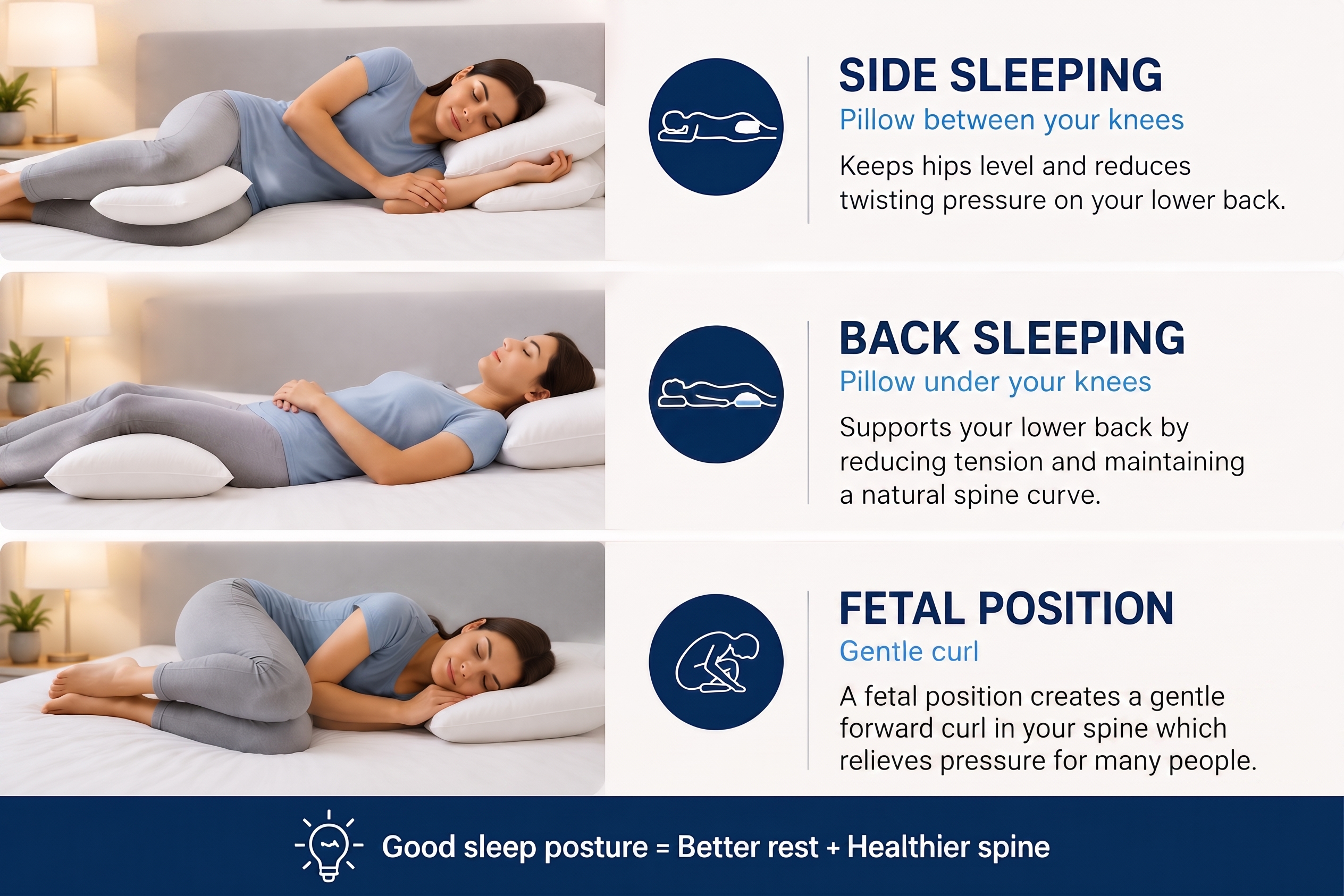
Side sleeping with a pillow between your knees works well for a lot of people. Keep your legs fairly straight and place a firm pillow between your knees. This keeps your hips level and takes the twisting pressure off your lower back. Skip the pillow, and your top leg tends to drop forward, pulling your spine out of a neutral position for hours.
Sleeping on your back with a pillow under your knees is another solid option. Lying on your back spreads your weight out evenly, which is part of why it’s often called the safest default position. Adding a pillow under your knees bends your hips just enough to take tension off your lower back instead of flattening it.
Curling into a fetal position can help some people with a low back problem, since it opens up space between the vertebrae. But curling too tightly shifts your weight unevenly and can leave other areas stiff. A gentle curl works better than pulling your knees all the way to your chest.
What Is the Best Sleep Position for Neck Pain?
Back Sleeping With the Right Pillow Height
Back sleeping with the right pillow height is usually the best place to start if your neck is the problem. You want a pillow that supports the curve of your neck without letting your chin sink or letting your head tip too far back. Research on pillow height has found that matching a pillow to a person’s neck and shoulders can meaningfully reduce neck pain over time.
Side Sleeping With Proper Neck Support
Side sleeping can also work, as long as your pillow is thick enough to keep your head level with the rest of your spine. Most side sleepers need a slightly thicker pillow than back sleepers do, since it has to fill the space created by the shoulder.
How to Choose the Right Pillow for Neck Pain
Your pillow is responsible for maintaining the natural curve of your cervical spine for seven to eight hours every night. When a pillow lacks the right height or firmness, your neck muscles stay contracted to hold your head in place instead of relaxing. Finding a pillow that supports your specific sleeping position keeps your spine neutral, takes pressure off delicate joints, and prevents you from waking up stiff or sore.
How High Should Your Pillow Be for Neck Pain?
The ideal pillow height, or loft, depends on how you sleep:
- Back Sleepers: You need a low- to medium-loft pillow. If it is too high, it thrusts your chin toward your chest and strains the muscles at the base of your skull. If it is too flat, your head drops backward and compresses the joints in your neck. The optimal pillow fills the small gap under your neck while allowing your head to rest flat with your nose pointing straight toward the ceiling.
- Side Sleepers: You require a firmer, higher loft pillow to bridge the broader gap between your ear and the outer edge of your shoulder. A pillow that is too thin lets your head sag downward, while one that is too thick tilts your head upward toward the opposite shoulder. In both cases, the lateral bend places uneven pressure on your spinal discs and pinches nearby nerves. The goal is a straight, horizontal line from your nose down through your sternum.
Can Sleeping With Too Many Pillows Cause Neck Pain?
Stacking multiple pillows might feel cozy at first, but it almost always creates too much elevation. When you sleep on two or more pillows, your head is forced into an unnatural, forward-tilted angle for hours at a time. This unnatural bend overstretches the posterior neck muscles, compresses the upper cervical spine, and restricts healthy blood flow. Instead of soothing your pain, stacked pillows frequently trigger morning stiffness, upper trap spasms, and tension headaches that radiate up into your temples. A single pillow with the correct height and contour is always the healthier choice.
Which Sleeping Habits Can Make Back and Neck Pain Worse?
- Stomach sleeping puts more strain on your neck than any other position. Depending on your mattress’s firmness, it can flatten your spine’s natural curve and force your neck to stay turned to one side for hours. However, if you have a lumbar disc problem, this is the optimal sleeping position for your lumbar disc, but it increases the risk of neck problems.
- Using your phone or reading with your neck bent forward right before bed can add to neck strain, especially if your neck is already irritated from spending hours in that position during the day. People typically do this by stacking multiple pillows in bed.
- An old, flattened pillow will eventually stop supporting your neck the way it used to, even if it still looks fine.
- Falling asleep slumped on the couch puts the same strain on your spine as a bad sleep position.
When Should You See a Chiropractor for Morning Back or Neck Pain?
Changing your sleep position solves a lot of everyday stiffness, but it isn’t always the full answer. It’s worth having your spine checked if your pain sticks around for days or weeks despite trying a new position. This is especially true if the pain spreads down an arm or leg, if you’re waking up with headaches most mornings, or if it’s limiting how you move during the day.
What to Expect at Our Southeast Valley Clinics
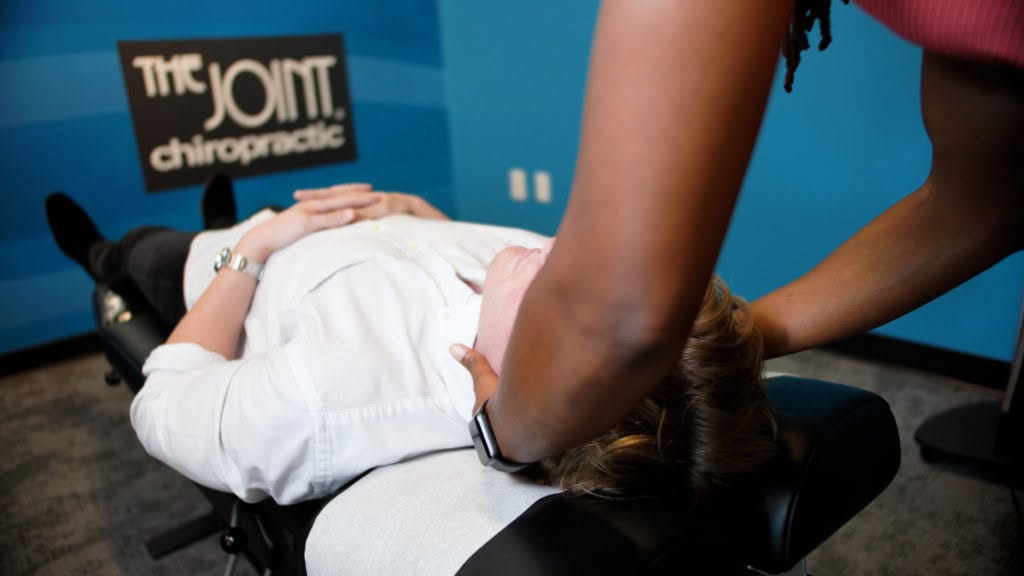
At The Joint Chiropractic, that exam happens on your first visit, with no referral and no appointment required. A licensed Doctor of Chiropractic will review your health history, ask about your symptoms and sleep habits, perform a spinal examination, explain the findings, and determine whether chiropractic care is appropriate.
If the doctor determines that your pain could be attributed to your sleep position, she/he will discuss options and ideas to address the underlying problem. They will work with you to figure out the best sleep position. The most important thing is that you actually get good sleep. That matters more than anything. The goal is good sleep and no pain.
Walk into your nearest Southeast Valley clinic today: Power Ranch, Mesa Gateway, San Tan Village, Queen Creek, and San Tan Valley-Gilbert
If you’d like to know what a first visit involves from start to finish, take a look at our guide on what to expect at your first chiropractic visit.
If you’d like to know what a first visit involves from start to finish, take a look at our guide on what to expect at your first chiropractic visit.
The $29 new patient visit covers your consultation, spinal exam, and first adjustment. You can review your options ahead of time on the pricing page.
Real Results from Local Patients
“Dr. Brian and Susan are awesome!! Dr. Brian helped remove a nasty knot from my neck-shoulder area and gave me my right arm back! ” – M. Bilgrami
“Dr. Alaouie has been amazing with helping to relieve my neck and back pain. I came in with a strong migraine, and I felt better as soon as he was done treating my neck in his office. He’s such a miracle worker! I’ll definitely keep coming back.” – E. Sarreal
“The doctors and customer service are amazing. I came in with almost constant numbness in my back. After one month, I have most of the feeling back, and my quality of life has improved so much.” – E. Bacon
See what patients near you say: Power Ranch, Mesa Gateway, Queen Creek, San Tan Village, and San Tan Valley.
Frequently Asked Questions About Sleep Positions and Pain
What is the best sleep position for neck pain?
Back sleeping with a pillow that supports your neck’s natural curve is usually the safest place to start. Side sleeping works too, as long as your pillow keeps your head level with your spine.
What is the worst sleep position for back and neck pain?
Stomach sleeping is bad for your neck. Side sleeping without a pillow for your low back.
How long does it take to get used to a new sleep position?
Give it two to three weeks of consistent effort. Waking up back in your old position now and then is a normal part of the switch.
Can changing my pillow really help with neck pain?
Yes. Pillow height changes how your neck lines up while you sleep, and research has tied a properly fitted pillow to real reductions in neck pain.
Do I need an appointment at The Joint Chiropractic in the Southeast Valley?
No. All five Southeast Valley locations, including Power Ranch, Mesa Gateway, San Tan Village, Queen Creek, and San Tan Valley-Gilbert, offer walk-in chiropractic care with no appointment and no insurance needed.
Still Waking Up With Back or Neck Pain?
If you’ve adjusted your sleeping position and pillow but continue waking up with back or neck pain, it may be time to look at what else is contributing to your symptoms.
At our Southeast Valley clinics, a licensed Doctor of Chiropractic will review your symptoms, evaluate how your spine is moving, explain the findings, and determine whether chiropractic care is appropriate.
In our Google reviews, patients frequently mention how much relief they get from a few simple adjustments, on top of the sleep changes they make at home.
Walk-ins are always welcome at our five Southeast Valley locations, with no appointment or insurance required. Visit our clinics today, or find the location closest to you to claim your $29 new patient consultation, exam, and initial adjustment.
Disclaimer
This article is for general informational purposes only and does not provide medical or chiropractic diagnosis or treatment recommendations for any individual person. Always consult a qualified healthcare professional for an examination, diagnosis, and personalized treatment plan.
References
Nam, D. C., Chang, K. B., & Choi, S. (2021). Changes in neck pain and somatic symptoms before and after the adjustment of the pillow height. Journal of Physical Therapy Science. https://pmc.ncbi.nlm.nih.gov/articles/PMC9889209/
Ren, S., Wong, D. W., Yang, H., Zhou, Y., Lin, J., & Zhang, M. (2016). Effect of pillow height on the biomechanics of the head-neck complex: Investigation of the cranio-cervical pressure and cervical spine alignment. PeerJ, 4, e2397. https://pmc.ncbi.nlm.nih.gov/articles/PMC5012320/
Keck Medicine of USC. (n.d.). The best and worst sleep positions for back pain. https://www.keckmedicine.org/blog/the-best-and-worst-sleep-positions-for-back-pain/